The agentic AI revolution in retail
In this report, we explore how agentic AI revolutionizes the retail industry and outline enablers for building the agent-ready enterprise. The retail industry stands at a transformation point. Agentic AI marks a shift from experimental use cases to operational scale. The priority now is execution - embedding AI into core processes to drive efficiency, relevance, and growth.
Key findings
- Agentic commerce is moving from vision to impact: Agents will drive up to 15% of European e-commerce spending by 2030, with adoption at a pace of up to four times faster than traditional e-commerce
- Agentic AI delivers dual impact: Driving a 30% reduction in operational costs for customer service by 2029 while 89% of U.S. retailers report that AI initiatives positively impact revenue
- Value chains evolve from linear to autonomous: Agentic AI transforms the retail value chain from sequential workflows into continuously orchestrated, real-time ecosystems
- Agentic AI will redefine retail, the winners move early and build agent-ready foundations now
What is agentic commerce?
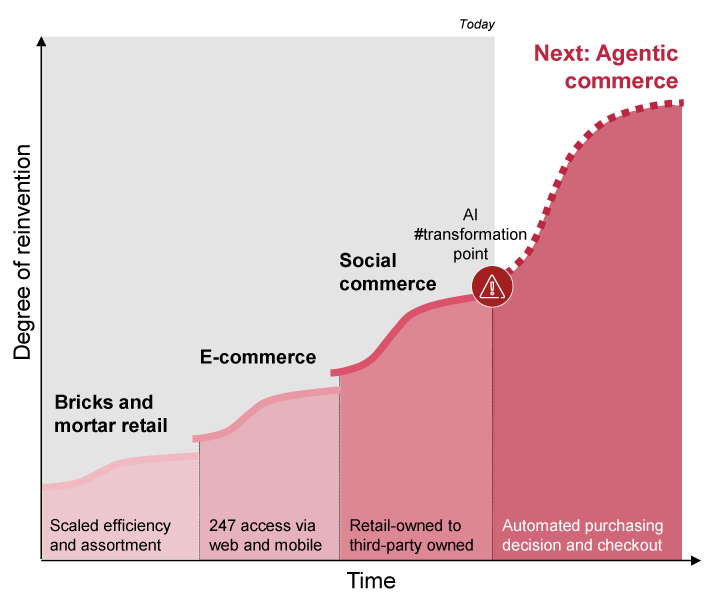
Agentic commerce describes a shift from AI-assisted human decision-making to autonomous agents that negotiate, decide, and execute end-to-end economic transactions - across consumer shopping and enterprise procurement.
- Geopolitical volatility demands continuous risk sensing and adaptive market compliance: 25% of German CEOs view geopolitical conflicts as their biggest threat. AI agents drive flexible real-time sourcing, pricing, and operations
- Supply chain upheaval requires real-time orchestration across fragmented networks: By 2030, the competition from fully-integrated ecosystems powered by AI is expected to grow by 40%. Tech players (Google, OpenAI, Anthropic) establish strong retail partnership networks
- Disruptive competitors leverage data-powered ecosystems and agentic platforms to shape supply and demand: Industry frontrunners already leverage agentic use cases from procurement to commerce. 17% of those adopting agentic AI do so in almost all workflows and functions
- Tech-savvy customers expect a coherent and personalized experience across channels: By 2030, 33% of consumers expect to make purchases with AI. Visibility is revenue-critical as LLMs become top-of-the-funnel.


