1372 notes tagged as ["trends"]
Filter your results by choosing one or more tags below or type your query in the search field above.
-

For years, retailers have optimized for a single moment: the website visit. How do we drive more traffic to our site? How do we increase time on page? How do we move shoppers from homepage to product detail to checkout? That model, however, is breaking down.
Right now, a meaningful and rapidly growing segment of your highest-value customers are making purchase decisions before they ever reach your site. They’re doing so via an artificial intelligence assistant. These AI agents include tools like ChatGPT, Perplexity, Google AI Overviews, and emerging shopping assistants that help consumers research, compare and select products before visiting a retailer’s site. By the time a consumer arrives at your product page, the consideration work is done. They’re there to buy.
-

Generative AI isn’t just changing how consumers shop, it’s breaking the demand patterns us retail was built on. The arrival of generative AI as a mainstream consumer shopping tool has produced one of the more significant behavioral shifts in US retail in the last decade. The Locus Q2 2026 US Consumer Survey found that 45% of US consumers now use AI tools like ChatGPT, Claude, and other AI assistants, as either a primary or secondary tool when researching or deciding what to buy online. The adoption isn’t evenly distributed. Nearly 60% of Millennials and 50% of Gen Z use AI to shop online, with 23% of Millennials and 17% of Gen Z treating AI as their primary research tool. Men adopt AI as a primary shopping tool at nearly 20% across generations; women adopt at 12%. The behavior is no longer emerging, it’s the operational reality retail fulfillment now serves.
-

Remember Jarvis from “Iron Man”? Before generative artificial intelligence became part of everyday conversation, Tony Stark had something most of us could only imagine — an intelligent assistant that understood context, anticipated needs, answered questions, and helped him make decisions in real time. Jarvis wasn’t just a search engine. He wasn’t a static database of information. He understood what Stark was trying to accomplish and helped guide him toward the best outcome.
-
You are currently enjoying the free trial mode which gives only back 3 results for each of your searches.
Click on Reset Search Tags to try another search.
Free NewsletterOnly paid members can get full access to the most recent content, create their own tags & personal folders, assign search results to specific projects and much more… all of this for less than 99c a day.
-

Building websites that AI can shop
More than half of consumers (58 percent) have replaced traditional search engines with generative artificial intelligence tools for product recommendations. That figure was 25 percent just two years earlier. Your next storefront visitor may not be a person at all. It may be a large language model (LLM) deciding whether to recommend your products.
Most product pages were never built for this kind of visitor. They were designed around human browsing patterns, optimized for Google’s crawlers, and organized by categories that make sense to shoppers clicking through menus. AI engines operate differently. They parse, embed and synthesize. They look for semantic clarity, structured relationships between entities, and factual density. A product page that works for a human shopper may be completely invisible to ChatGPT, Perplexity, or Google’s AI Overviews.
-

Is the retail industry ready for the booming “chat” economy?
Don’t search, just ask. That’s shorthand for a profound change that is quietly but quickly forcing retailers to rethink how they market, how they structure their websites, and how to deal with the inevitable sunset of traditional search advertising.
According to reports on industry news sites, there appear to be a lot of retailers who are just now scrambling to catch up. The cost to retool websites to synch with AI is enormous. There may be a number of retailers, especially those who sell direct-to-consumers, who do not survive the transition. And it’s coming faster than most realize.
-
Agentic commerce and the future of payments
Be the payment option agents can see and customers can trust. In 2030, we estimate that more than 30% of online commerce could run through AI agents, representing close to $3.1 trillion in transactions.1 Those projections should immediately focus the minds of every payments leader on strategy. Why? Because the entire logic of how payments compete is about to change.
For decades, payments platforms mattered because they converted human intent into completed transactions. But they didn’t influence what a customer chose to buy. Now they do. As people enable AI agents to take control of the purchase journey, agents can compress every step from discovery to checkout into a single, optimized and automated decision layer, including payment selection.
-
Agentic commerce: Make your brand unmissable
Staying visible, chosen and trusted as agents reshape commerce and customer relationships. Digital commerce never lived up to its promise. Yes, it increased choice and made buying easier. But consumers got overwhelmed by options and information, and now often struggle to make decisions. Brands are absorbing the cost in abandoned carts, high return rates, eroding margins and non-stop spending to reacquire the same customers.
-
2026 influencer marketing report: The next wave of influence
The influencer marketing landscape is changing, with both its importance and its scope expanding. As influencer marketing investments rise, what was once an experimental tactic has become a sophisticated, highly funded go-to-market framework. But marketing teams face growing pressure from leadership to demonstrate measurable ROI. Millions of dollars are wasted on partnerships that look strong on paper but fail to convert, driven by a misalignment between brands and creators and an over-reliance on traditional, follower-first sourcing playbooks.
-
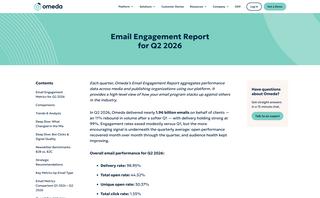
Email engagement report for Q2 2026
Curious about how your team’s email marketing efforts compare to others in the media industry? Each quarter, Omeda releases aggregated, anonymized data from client emails sent from our platform so you can understand how your emails are performing. In Q2 2026, Omeda delivered over 1.96 billion emails on behalf of clients from our platform.
Covered in this report:
Email benchmarks for media industry emails sent in Q2 2026
-

Meaning is the new currency of luxury
The luxury goods market is undergoing a shift unlike any in recent memory. After two years of declining sales —dropping 3% from $417 billion (€369 billion) in 2023 to $405 billion (€358 billion) in 2025— Bain & Company, in association with Altagamma, now reports that first-quarter 2026 fell between 3% to 5% from an already weak first quarter 2025, when it declined 1%.
While the firm expects momentum to return as geopolitical and economic shocks ease—projecting a modest 2% to 4% year-over-year rebound to between $412 billion and $421 billion—the potential recovery is far less robust than after the 2008/2009 downturn. That time the decline was sharper—losing 9% over the two years—but it snapped back even stronger—up 16% from its pre-crisis level in 2007.
-

AI Agents are becoming the new front door to shopping
AI agents are changing how shoppers discover, compare, buy, track, return, and get support. The retailers that stay visible inside those conversations will win the next era of commerce. The ones that don’t may never make the shortlist.
This eBook maps the shift from website-first commerce to agent-mediated, conversation-led experiences, and what it takes to become agent-ready now. You’ll see how marketing, sales, and service are collapsing into one intelligent AI layer, and why static sites and disconnected CX stacks won’t keep up.