320 notes tagged as ["Customer engagement"]
Filter your results by choosing one or more tags below or type your query in the search field above.
-
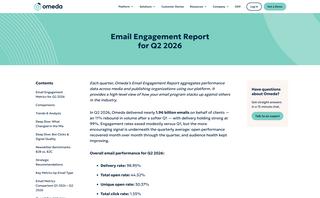
Curious about how your team’s email marketing efforts compare to others in the media industry? Each quarter, Omeda releases aggregated, anonymized data from client emails sent from our platform so you can understand how your emails are performing. In Q2 2026, Omeda delivered over 1.96 billion emails on behalf of clients from our platform.
Covered in this report:
Email benchmarks for media industry emails sent in Q2 2026
-
The customer has evolved. It’s time marketing does too. Today’s consumer isn’t the same as they were three years ago. They don’t just engage with marketing. They dissect it, exploit its patterns, and discard whatever doesn’t serve them. This is the apex consumer. On the other hand, marketing appears more advanced than ever, but it’s operating on a model built for a slower, more predictable game—one consumers have already moved past.
-

Nearly half of consumers already receive beauty recommendations from generative AI. At the same time, e-commerce is growing 6x faster than in-store , and global beauty sales continue to expand at a double-digit pace.
A new generation is coming of age in this environment: digitally fluent, highly informed, and redefining how beauty is discovered, evaluated, and experienced. Gen Alpha is blending AI-powered exploration with real-world interaction , setting new expectations for personalization, trust, and engagement across every touchpoint.
-
You are currently enjoying the free trial mode which gives only back 3 results for each of your searches.
Click on Reset Search Tags to try another search.
Free NewsletterOnly paid members can get full access to the most recent content, create their own tags & personal folders, assign search results to specific projects and much more… all of this for less than 99c a day.
-

How can behavioral segmentation drive engagement and loyalty
Segmentation has long played a role in targeting different consumer groups. Demographics and location data were first, offering a powerful way to target customer segments based on what they’re likely to want.
With new technology, it’s now possible to understand consumers on an even deeper level. Customer habits and actions say a lot about their purchasing behavior, and understanding these factors is vital to optimizing our marketing campaigns.
-

Why traditional retail metrics break down in agentic commerce
Retailers are no longer asking whether artificial intelligence belongs in the business. Nearly every organization is experimenting with AI in some form, whether through personalization engines, predictive inventory tools, customer service assistants, or emerging agentic experiences. The challenge now is understanding how to measure its impact as AI increasingly shapes discovery, decision-making and customer engagement.
-

Why retailers are bringing back the catalog, but making it digital
Acquiring a new customer has never been cheap. But the past few years have made it significantly more expensive. CPCs are up. Organic reach has narrowed. The performance marketing channels that powered a decade of retail growth are delivering diminishing returns, and retail teams are feeling it in their budgets.
The usual instinct is to look for the next new thing. What’s emerging instead is a format that predates the internet entirely.
-

Trust is the new currency in commerce media
For years, digital advertising operated on a simple premise: more visibility drives more growth. Impressions, placements, targeting, reach: the levers were obvious, and everyone pulled them. But consumers have changed.
Today’s shoppers are more skeptical, more privacy-conscious, and more selective about the brands they engage with. They’re quicker to abandon experiences that feel intrusive and increasingly resistant to advertising that interrupts rather than helps. In an era shaped by signal loss, rising acquisition costs, and AI-generated noise, marketers are discovering that attention alone is no longer the most valuable asset in commerce.
-

How to grow your social media following (without buying followers)
Growing a genuine social media following comes down to three things: creating content people actually want to share, engaging with your community like a real person, and showing up consistently enough that algorithms reward you. There are no shortcuts that don’t eventually backfire — but there are strategies that compound over time and attract the kind of followers brands actually care about.
Why engagement rate matters more than follower count (and how brands measure it)
-

TikTok launches branded first-screen ads
TikTok is expanding the way advertisers can appear the moment users open the app, turning the platform’s launch page into a dedicated branded placement that advertisers can buy programmatically. The move, announced in recent industry briefings and visible in pilot campaigns this month, adds to existing ad formats such as TopView and Brand Takeover and aims to make the opening screen a predictable space for high-impact mobile ads. For marketers, the update promises greater brand visibility at scale; for users, it raises fresh questions about feed experience and early-session user engagement. The change arrives as platforms rework monetization levers across short-form video, and it immediately reshapes options for major advertisers — from global apparel groups to DTC brands — seeking guaranteed impressions in the first seconds of app use.
-

For years, Pinterest was the mood board. Now it’s the cash register too
Open up your latest media plan. You’ll probably see a familiar pattern. Channels that drive discovery are often judged on awareness metrics, not on the downstream business impact they can create. That feels sensible, until you look at when people actually choose what goes into the basket.
Those decisions often happen earlier, while someone is still planning, comparing and building a shortlist. If you only measure those early moments on recall or reach, you miss the sales they unlock later. This is where Pinterest fits.
-

Ultimate guide to influencer engagement metrics
Grasping influencer engagement metrics is a cornerstone for running impactful marketing campaigns in 2026. The focus has shifted from surface-level metrics like follower counts to more meaningful interactions such as saves, shares, and the sentiment behind comments. This change reflects how brands now gauge performance, with 89% of marketers prioritizing engagement metrics as their top indicator of success.