176 notes tagged as ["conversion"]
Filter your results by choosing one or more tags below or type your query in the search field above.
-

eCommerce conversion optimization is the practice of improving the share of shoppers who complete a purchase, using both on-site levers and engagement-driven ones. Conversion isn’t only an on-site problem. A lot also happens after the click, through cart recovery, personalization, and cross-channel messaging that bring shoppers back to buy.
In this guide, you’ll get a clear definition and a formula to work with. You’ll also find out realistic benchmarks, the on-site and engagement levers that move the conversion rate, and how to prioritize them.
-
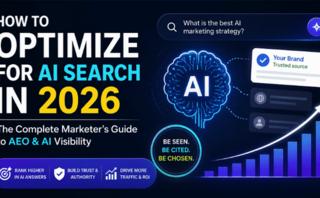
For years, website marketing meant search visibility: ranking for the right queries and earning the click. The way people search has changed. They still use Google, but they also ask AI tools for direct answers. These tools draw on training data and the sources they retrieve to decide which brands are credible enough to surface or cite.
That shifts the goal from visibility to credibility: proof that your brand is trustworthy enough to be recommended. The techniques are largely the same. What they’re accomplishing is different.
-

The early data on artificial intelligence shopping is in and it has a story to tell. Shopify reported that shoppers who arrive at e-commerce sites through AI platforms like ChatGPT, Perplexity, and Gemini are 50 percent more likely to convert to purchase than those coming from organic search. Not only are they more likely to make a purchase but when they do, they spend 14 percent more per order. More than half of these AI-referred sessions land directly on a product page, ready to buy.
-
You are currently enjoying the free trial mode which gives only back 3 results for each of your searches.
Click on Reset Search Tags to try another search.
Free NewsletterOnly paid members can get full access to the most recent content, create their own tags & personal folders, assign search results to specific projects and much more… all of this for less than 99c a day.
-
Most brands use discounts as a substitute for messaging
Most ecommerce welcome flows underperform for one reason: they rely on a discount to do all the work. A percentage-off offer might get the first purchase, but it does very little to build trust, educate the customer, or increase long-term value. The highest-performing welcome flows don’t remove discounts entirely — they build enough conviction before the conversion ask happens.
Key Takeaways
Discounts don’t fix weak welcome flow strategy
-
8 Challenges faced by online businesses in Central and Eastern Europe
Running a business online comes with numerous challenges due to the fast-moving environment , where customer expectations are higher, competition is just a click away, and technology keeps evolving. Still, moving online is clearly worth it.
In Central and Eastern Europe (CEE), 73% of people shop online, so if your business isn’t there, you’re missing a large share of customers. The European e-commerce market itself is huge, too, expected to reach €353.5 billion in 2026 and keep growing.
-
How to increase checkout conversion: 10 tested strategies for merchants
Learn how to increase checkout conversion by reducing friction, simplifying payments, and giving customers a faster, more seamless buying experience. To increase checkout conversion in 2026, you need to remove anything that slows customers down or makes them hesitate at the final step. This matters because the average 2026 checkout conversion rate in Europe is just around 20%. That means that out of 100 people who initiate the checkout process, only 20 actually go through with the purchase , while the rest drop off somewhere along the way.
-
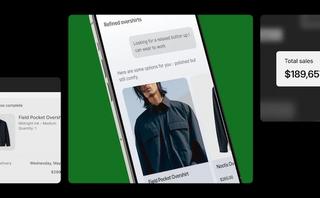
AI-referred shoppers convert better and spend more
AI is changing how consumers discover and purchase products online, and it’s happening fast. AI-referred shoppers on Shopify convert at nearly 50% higher rates and carry 14% higher average order values than organic search. Here’s what the early data says about how AI is reshaping commerce—and why the window to act is right now. Seemingly every week, there’s a new update or capability that makes a more compelling case for shoppers to use AI as their default shopping channel. But for all the discussion about what’s changing and what it means, most of it is heavy on predictions and short on actual behavioral data.
-
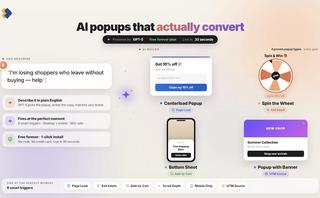
Top 5 AI popup tools to boost conversions in 2026
Not every tool that calls itself an AI popup builder earns the title. The word “AI” gets attached to everything from basic exit-intent rules to genuine machine learning, so it’s worth knowing what to look for before you commit. A truly AI-powered popup tool does at least some of these things without manual input:
1. AI-assisted creation
You describe what you want in plain language, or simply enter your URL and pick a goal, and the tool builds a complete, branded popup for you: copy, design, and targeting rules included, in minutes.
-

Mixed reports on AI ecommerce traffic
Consumers arriving from AI search and chat may be high-intent and ready to buy, but the early evidence is uneven and easily misread. AI-referred visitors are engaging more deeply and converting at higher rates, according to the April 2026 Adobe Digital Insights “Quarterly AI Traffic Report” ( PDF).
Premium Engagement
AI-referred visitors in March were 42% more likely to purchase, according to Adobe, generating 37% more revenue per visit than visitors from other channels.
-
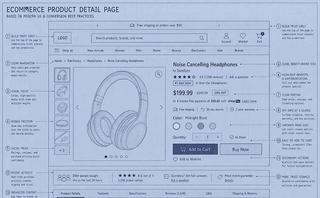
Rethink your product detail pages
Conversion is the primary job of ecommerce product pages. Ranking in search engines has always been a close second. Until now. It’s near cliché in 2026 to note that search and product discovery are changing. AI Overviews, AI Mode, various answer solutions, AI chat interfaces, and emerging shopping agents are remaking how consumers find and buy, from luxury items to everyday goods. Conversion is the primary aim of a product detail page. But it should also attract traffic via traditional rankings and generative AI visibility.
-

The e-seller's guide to cross-border growth 2026
This report synthesizes consumer behavior and other market insights across a dozen major destination markets in Europe, North America and Australia, some of Landmark Global’s key destination countries, to help e-tailers understand where expectations converge, where operational choices matter most, and how e-logistics performance increasingly determines success in cross-border expansion.
What you’ll find inside: