1395 notes tagged as ["Best practice"]
Filter your results by choosing one or more tags below or type your query in the search field above.
-

As retailers pour investment into customer-facing artificial intelligence, are they overlooking the operational foundations that decide success? The race to put an AI face on retail is accelerating. Shopping assistants, conversational storefronts, and agentic checkout powered by the likes of Gemini and ChatGPT — attention and budget are gravitating toward the customer interface. Yet critical vulnerability sits behind it, unaddressed.
-

Context, not content, now drives AI visibility, making structured data the strategic data layer every enterprise must prioritize. The way people find and consume information has shifted. We, as marketers, must think about visibility across AI platforms and Google.
The challenge is that we don’t have the same ability to control and measure success as we do with Google and Microsoft, so it feels like we’re flying blind.
-

The 2026 Global Unified Commerce Benchmark analyzes how leading retailers around the world use unified commerce to improve operational efficiency, customer experience, and profitability. Based on industry data and executive insights, the report identifies the cost of inaction and the strategies top performers use to stay competitive.
Why unified commerce matters for retail leaders
Retailers worldwide face mounting pressure to deliver seamless customer experiences across every channel. The 2026 Global Unified Commerce Benchmark reveals how leading brands succeed across Shopping, Checkout, Fulfillment, and Service. Retail leaders gain actionable insights into industry best practices, competitive positioning, and strategic opportunities to elevate their customer experience strategy.
-
You are currently enjoying the free trial mode which gives only back 3 results for each of your searches.
Click on Reset Search Tags to try another search.
Free NewsletterOnly paid members can get full access to the most recent content, create their own tags & personal folders, assign search results to specific projects and much more… all of this for less than 99c a day.
-

Retail spends more on AI and getting less back
New research across 300 consumer industry executives reveals a striking paradox: retail companies outspend nonretail peers on commercial AI, yet expect significantly lower returns. We recently surveyed more than 300 consumer industry executives, managers, and specialists on how their companies are applying AI to commercial functions, with a sample split nearly evenly between retail and nonretail industries. What we found was striking. Not because of what companies are doing, but because of what they openly admit they’re not doing.
-

Building websites that AI can shop
More than half of consumers (58 percent) have replaced traditional search engines with generative artificial intelligence tools for product recommendations. That figure was 25 percent just two years earlier. Your next storefront visitor may not be a person at all. It may be a large language model (LLM) deciding whether to recommend your products.
Most product pages were never built for this kind of visitor. They were designed around human browsing patterns, optimized for Google’s crawlers, and organized by categories that make sense to shoppers clicking through menus. AI engines operate differently. They parse, embed and synthesize. They look for semantic clarity, structured relationships between entities, and factual density. A product page that works for a human shopper may be completely invisible to ChatGPT, Perplexity, or Google’s AI Overviews.
-
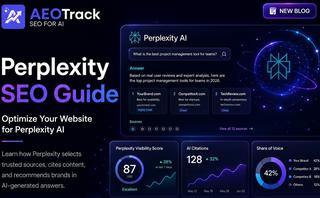
Perplexity SEO: How to get cited in Perplexity AI answers
Perplexity SEO optimizes your content to be cited in Perplexity AI’s real-time, fully attributed answers. This guide covers PerplexityBot access, content freshness signals, domain authority, answer formatting, and tracking Perplexity citations.
What is Perplexity SEO?
Perplexity SEO refers to optimizations that increase the likelihood of your content being cited in Perplexity AI responses. Perplexity AI is a real-time answer engine with over 100 million monthly users — and unlike ChatGPT or Gemini, its entire value proposition is transparent citation with live web retrieval.
-

eCommerce conversion optimization guide
eCommerce conversion optimization is the practice of improving the share of shoppers who complete a purchase, using both on-site levers and engagement-driven ones. Conversion isn’t only an on-site problem. A lot also happens after the click, through cart recovery, personalization, and cross-channel messaging that bring shoppers back to buy.
In this guide, you’ll get a clear definition and a formula to work with. You’ll also find out realistic benchmarks, the on-site and engagement levers that move the conversion rate, and how to prioritize them.
-
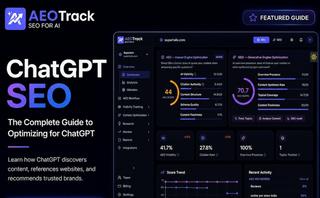
ChatGPT SEO: How to get your brand cited in ChatGPT answers
ChatGPT SEO is the set of optimizations that make your website more likely to be cited as a source in ChatGPT responses. This guide covers how ChatGPT selects sources, GPTBot access, FAQ schema, Bing indexing, content structure, and citation tracking.
What is ChatGPT SEO?
ChatGPT SEO refers to the set of optimizations that make your website more likely to be cited as a source in ChatGPT responses. Unlike traditional SEO — which targets blue-link rankings in Google — ChatGPT SEO targets your brand’s inclusion inside AI-generated text answers.
-
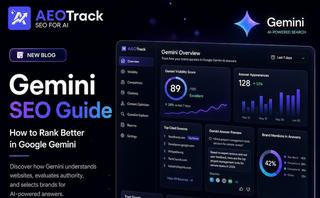
Gemini SEO: How to rank in Google Gemini and AI Overviews
Gemini SEO optimizes your website for inclusion in Google Gemini responses and Google AI Overviews. This guide covers Google-Extended bot access, structured data requirements, Core Web Vitals, EEAT signals, and how to track your Gemini visibility.
What is Gemini SEO?
Gemini SEO refers to optimizations that increase your brand’s inclusion in Google Gemini responses and Google AI Overviews — the AI-generated summaries that appear at the top of Google Search results pages.
-
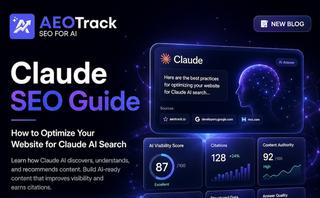
Claude SEO: How to get your brand featured in Claude AI answers
Claude SEO optimizes your content for citation in Anthropic’s Claude AI. This guide covers ClaudeBot and anthropic-ai bot access, content structure for factual accuracy, building authority signals Claude values, and tracking your Claude citation rate.
What is Claude SEO?
Claude SEO refers to optimizations that make your content more likely to be cited in Claude’s responses. Claude, developed by Anthropic, is one of the most widely used AI assistants globally — powering Anthropic’s Claude.ai, Amazon Bedrock, and countless third-party integrations.
-
How to build your AI-native marketing engine
AI only scales when your team can trust the system. 91% of marketing leaders say AI is central to their go-to-market strategy. Most enterprise teams are still stuck at the same stage: Beginner.
The gap between ambition and execution isn’t effort — it’s maturity. The teams seeing real impact aren’t working harder; they’ve moved up a stage. This guide shows you how to do the same across your four core workflows.